Communication by Design
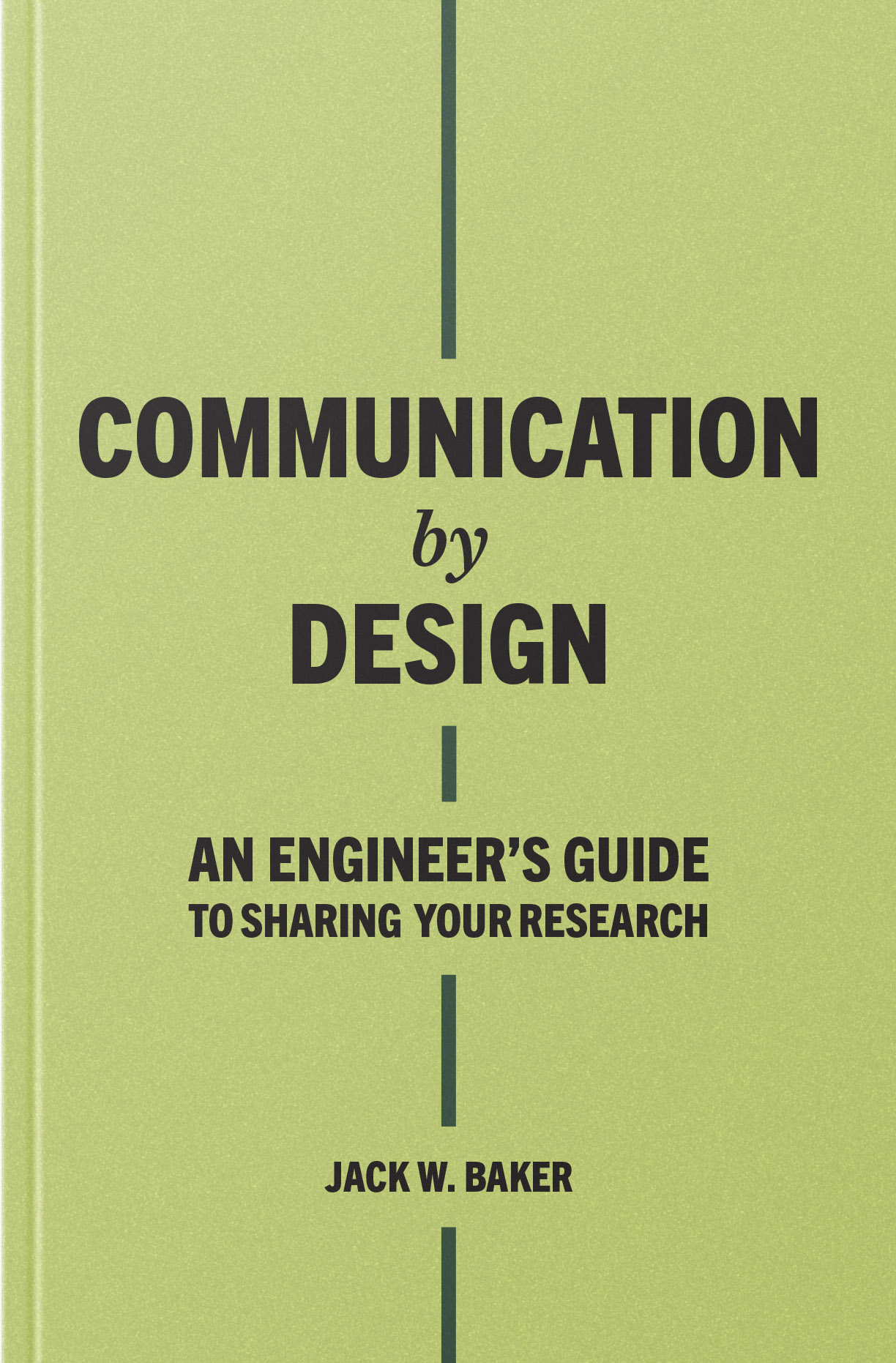
Most researchers communicate by mimicking the dense slides and jargon-heavy papers around them. The result: audiences tune out, reviewers misunderstand, and funders move on. Communication by Design shows you a systematic process to make your best technical work impossible to ignore. Along the way, you'll discover why your slides are sabotaging your message, why reviewer confusion is valuable data, and why being thorough is the opposite of being clear.
Order a signed hardcover
$40, shipped to US addresses.
Prefer a retailer, another format, or shipping outside the US?
IngramSpark · Amazon · Barnes & Noble · Bookshop.org · Books-A-Million
Ordering for your research group or class? Signed hardcovers are $30 each for 5 or more — email bakerjw@stanford.edu for details.
Praise for Communication by Design
"Baker clearly demonstrates why engineers need to communicate more effectively, and more importantly, he explains how to do it. Communication by Design provides specific, actionable advice to improve research communication and is now required reading for my research group."
— Ellen Rathje, NAE, Janet S. Cockrell Centennial Chair, The University of Texas, Austin
More praise
"Brilliant engineering alone does not change the world — understanding does. The most important ideas can be overlooked if they are not clearly communicated. Communication by Design shows engineers how to translate technical excellence into real-world impact."
— Reginald DesRoches, President, Rice University
"To solve tomorrow's most complex problems, technical skills won't be enough. Engineers must become outstanding communicators. This book shows you exactly how."
— Jerome Lynch, Dean of Engineering, Duke University
"Every STEM researcher needs this book, and I say that as someone who assumed I already knew how to communicate my work. The examples are genuinely interactive, the storytelling makes the takeaways stick, and the level of detail is surprising in the best way. Packed with clear, practical tips you can use right away."
— Favour Nerrise, Stanford 3-Minute Thesis competition winner, Electrical Engineering PhD Candidate
"Jack Baker has been a leading researcher and communicator in my field for twenty years. With this book, he pulls back the curtain to share the process behind his success."
— Ahmed Elbanna, Director, Statewide California Earthquake Center, \\ Professor, University of Southern California
"This book serves as an essential tool for researchers at different stages: from beginners to established researchers. It is a systematic, easy-to-digest, and immediately applicable guide."
— Yi Shao, Assistant Professor, McGill University
"This book is filled with priceless advice on how researchers can communicate their work clearly and effectively. I really wish I had a resource like this during my PhD."
— Irene Alisjahbana, Design of Data Lecturer at Stanford's d.school
"This fine book will be enormously helpful to students and faculty learning how to craft a talk, design a poster, write a paper or proposal, and navigate the review process. These essential elements of an engineer or scientist's career have rarely been explained in such a lucid and compelling manner."
— Ross S. Stein, Temblor, Inc. CEO; Stanford Geophysics Lecturer on Scientific Presentation, Presentations Instructor for the Seismological Society of America
"A practical, substantive text that will help any new scientist in their career."
— Jack Leeming, Chief Careers Editor, Nature
"Jack Baker's writing on effective communication shaped how I approach research presentations and papers. Communication by Design distills his insights into an actionable, systematic, researcher-friendly toolkit."
— Eyitayo Opabola, Assistant Professor, University of California, Berkeley
"As a former PhD advisee of Jack Baker's, I've found the writing and speaking skills I developed in his group invaluable in my career at Google. This book documents that training and makes it accessible to any reader."
— Nirmal Jayaram, Senior Director of Engineering, Google
What's Inside
- Audience-focused communication: A five-stage design process (Empathize, Define, Brainstorm, Prototype, Test) that provides conceptual scaffolding and helps overcome the anxious mindset you might bring to communication tasks.
- Presentations: Open with impact, maintain attention, and close so your audience remembers what matters. Includes assertion-evidence slide formats and using presentations to refine your message for later writing.
- Papers: Structure your arguments so reviewers say yes. Covers the IMRaD structure, guidance for each section, choosing effective titles, and navigating co-authorship decisions.
- Peer review: Understand the process from the journal's and reviewers' perspectives. Respond to reviewer comments effectively, choose where to publish, and handle challenging situations.
- Beyond presentations and papers: Apply the design process to proposals, teaching, conferences, posters, CVs, and advisor communication.
- Systems and tools: Build productive writing systems, conduct literature reviews, select software, and use AI tools as a design partner without letting them replace your judgment.
Resources
Related resources — checklists, templates, and example materials to accompany the book.
Media Coverage
- Stanford professor helps researchers connect with the right audiences — Stanford Doerr School of Sustainability profile on the book.
- Publishing Academic Research podcast, Episode 47 — Interview on writing clearly and communicating research to broader audiences.
Example Library
The book will be accompanied by a library of real before/after examples showing the design process in action. Submit your own work for possible feedback and inclusion in this library.
Sign up for book news and receive a free sample chapter.